BOOK RECOMMENDATION:

Book recommendation by Kristóf György Veres
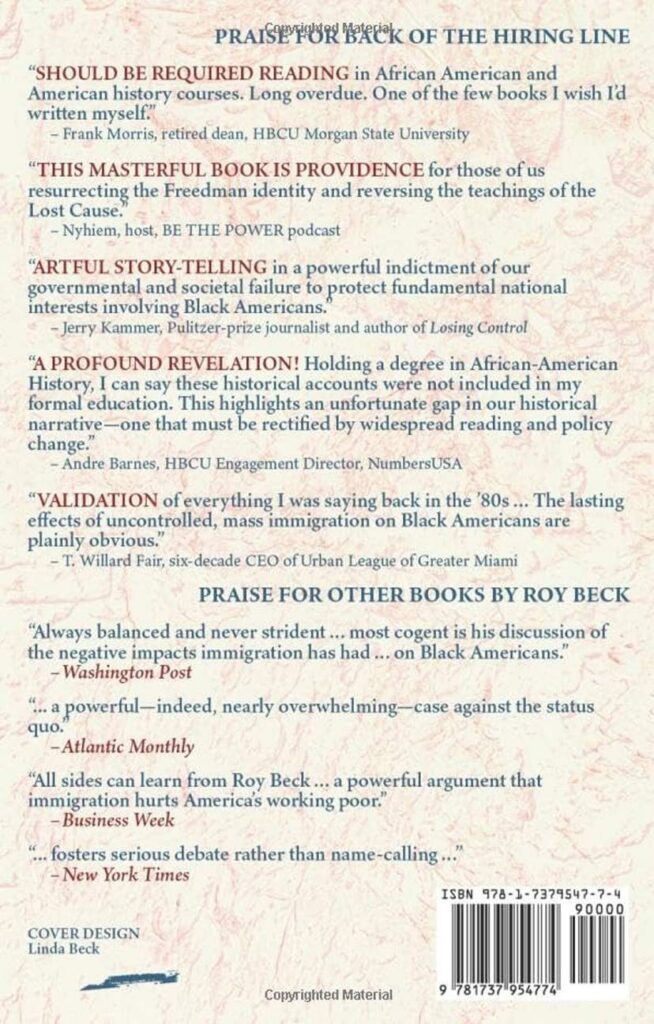
Roy Beck: Back of the Hiring Line. A 200-year history of immigration surges, employer bias, and depression of Black wealth. NumbersUSA, Arlington, Virginia, 2021.
-Published March 11, 2022
How is it possible that in late 2020, more than 150 years after the end of the Civil War, the median Hispanic household’s net wealth was 3 times higher than that of the median African American household? This comparison is even more striking if we consider the fact that a large majority of Hispanic immigrants arrived in the U.S. after 1960 mostly as unskilled workers without significant assets. According to Roy Beck’s Back of the Hiring Line this phenomenon – i.e., the displacement of African American jobs and the depression of Black wealth – can be linked to periods high immigration.
Beck argues that the primary responsibility lies with elected officials who tended to establish immigration policies without considering their impact on the most vulnerable members of the local population. Their inaction in turn enabled employers – the author also lays blame at their feet – to replace Black workers with immigrant labor. As Ronald F. Ferguson – quoted by Beck – summed up quite succinctly in 1995: „If employers hire from the front of the queue and if Blacks are disproportionately at the back – behind immigrants and native-born members of other racial groups – then Blacks will suffer the greatest deterioration in employment when the number of immigrants grows.”
Beck’s book doesn’t only examine the recent decades to establish the connection between high immigration and the depression of Black wealth, rather he covers the period between 1820 and 2020. His longue durée approach reminiscent of the French Annales School enables the author to employ an abundance of parallels between the great wave (1880s-1924) and the modern wave (1965-) of immigration. The picture that the author paints is the following: European immigrants of the late 19th century displaced African Americans in a similar fashion that Hispanic immigrants did after the 1960s. Consequently, the connection between sustained high immigration and the depression of Black wealth must be systemic.
The 330-page-long book is made up by a number of thematical chapters covering a wide range of topics (labor riots, multi-racial unions, collapse of middle-class occupations, Black advocacy for immigration reduction) that are in turn organized in large chronological blocks. All of these subdivisions expand on issues raised in the first chapter which provides a chronological overview of the 200 years covered in the book.
Already in the 1820s the abolitionist advocate Frederick Douglas – an ex-slave himself – tried to raise awareness about the perils of sustained high immigration to African Americans in the North: “Every hour sees the Black man elbowed out of employment by some newly arrived immigrant whose hunger and whose color are thought to give him a better title to the place.” During Reconstruction, African Americans enjoyed a short period of wealth expansion: as during the post-war demand for labor Northern employers had to heavily rely on the Black workforce. However, when the great wave of immigration commenced in the 1880s, African Americans started to get pushed out of the Northern workforce. With opportunities for Black workers declining many descendants of slavery “were forced to move back to the rural South in search of subsistence wages and former connections near the plantations.”
From the closing years of the 19th century, elected officials in Congress repeatedly tried to limit immigration with the House of Representatives voting to end the great wave in 1897, 1902, 1906, 1912, 1913, 1915, 1916, 1917, 1921 and 1924. The Senate passed restrictionist bills in 1897, 1898, 1912, 1915, 1916, 1917, 1921 and 1924. However, on the rare occasions when both chambers agreed, subsequent presidents vetoed the proposed legislation. When the Great Wave finally ended in 1924 only one in four African Americans was in the middle class. However, by the beginning of the 1970s – after forty years of moderate immigration – this figure increased to 75%. The years between 1924 and 1965 also saw the great migration of Black people to the North, with labor-hungry Northern industries recruiting millions of African Americans from the South. The era of significant wage increases ended after the passage of the Hart-Celler Immigration and Nationality Act of 1965.
Almost two-thirds of Beck’s book is dedicated to the years that followed the “destructive legislative accident” of 1965 that restarted massive immigration. Although proponents of the abovementioned bill promised little or no increase to annual admissions, the yearly average immigration of 300,000 of the preceding years ballooned to 450,000 by 1968 and further swelled to 600,000 by 1978. As African American labor was less and less needed, inflation adjusted low-skill wages started to steadily decline. By the end of the 1980s, a general collapse of middle- class blue-collar occupations was evident throughout the country.
Beck examines in detail how commission after commission from the 1970s onward recommended a reduction in annual immigration – unsuccessfully. Furthermore, immigration reform bills passed in 1986, 1990 and 1996 all resulted in even higher levels of immigration. Finally, a kind of equilibrium was reached by the beginning of the new millennium. Despite the lack of serious consideration by Congress to decrease annual immigration numbers from 2000 to 2020, every expansionist bill during these two decades was ultimately defeated on the Hill.
The most intriguing chapters, however, are not the ones covering legislative history or labor statistics. Beck sheds light on a number of intriguing phenomena that are connected to the depression of Black wealth after 1965. One of them is the seemingly benign practice of ethnic networking – i.e., the practice of hiring through immigrant networks using word of mouth advertising. However, if the practice becomes widespread – as it did in a number of urban centers by the 1990s owing to decades of high immigration – it can lock African Americans out of certain occupations. According to Beck, even affirmative action – originally designed by President Johnson to benefit the descendants of slavery – was hijacked by open-doors immigration policy. For example, in the 1980s a Portuguese-owned construction company was a significant beneficiary of minority set-aside contracts. The result: millions of dollars originally intended to help Black people went to European workers.
All in all, Roy Beck’s Back of the Hiring Line explores a previously neglected aspect of immigration history. Shedding light on the connection between periods of high immigration and the depression of Black wealth renders his book a must-read not just for experts of migration, but also for social justice advocates.