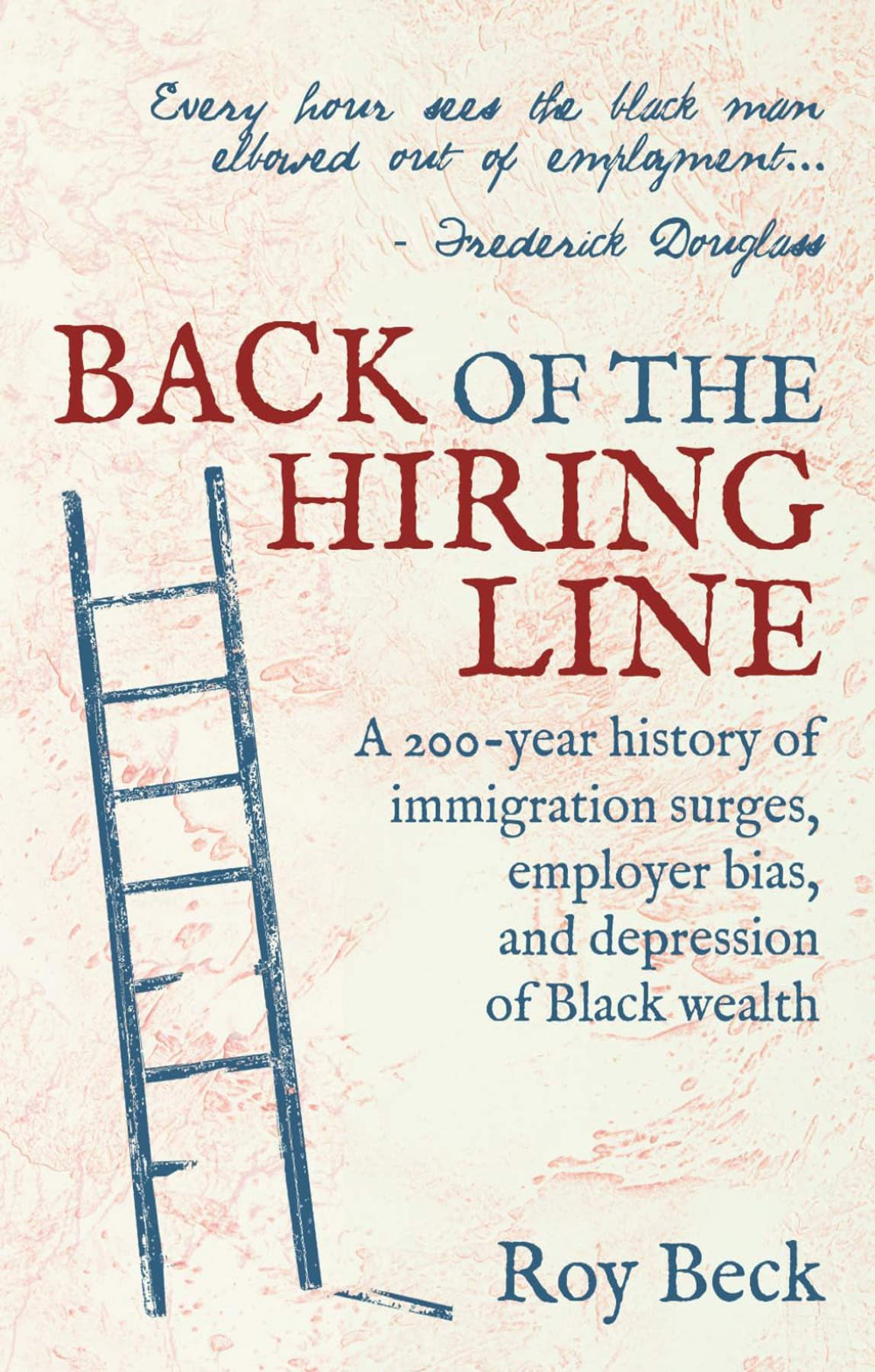
Press and Media Kit
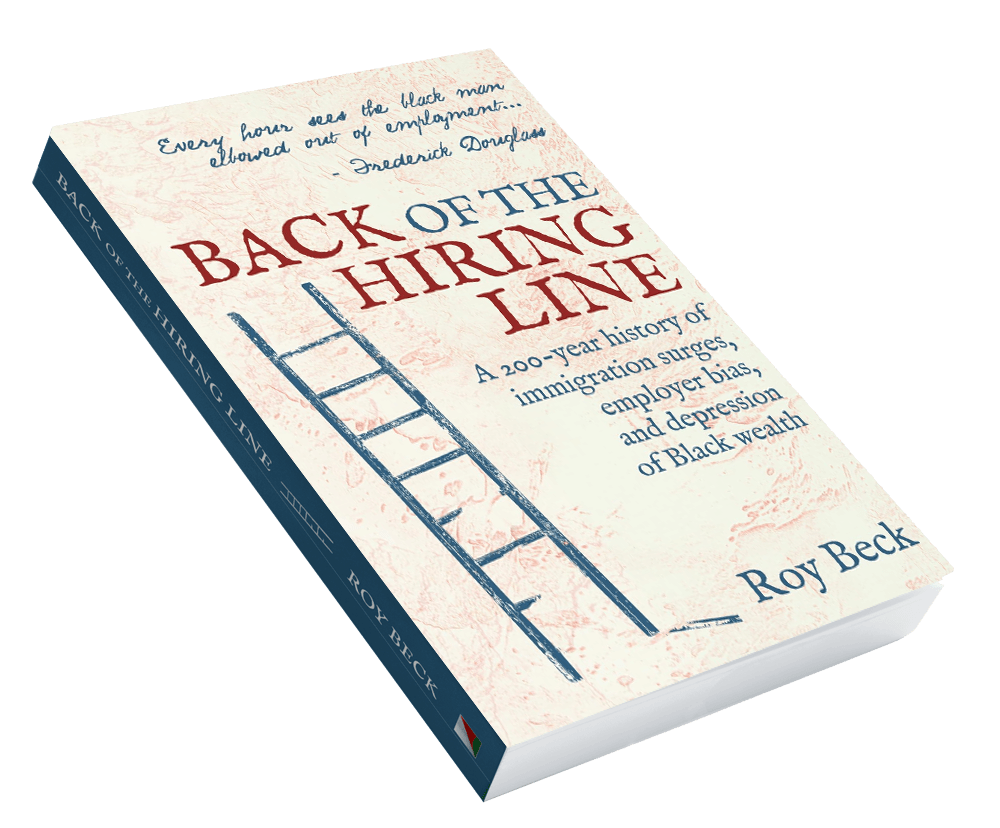
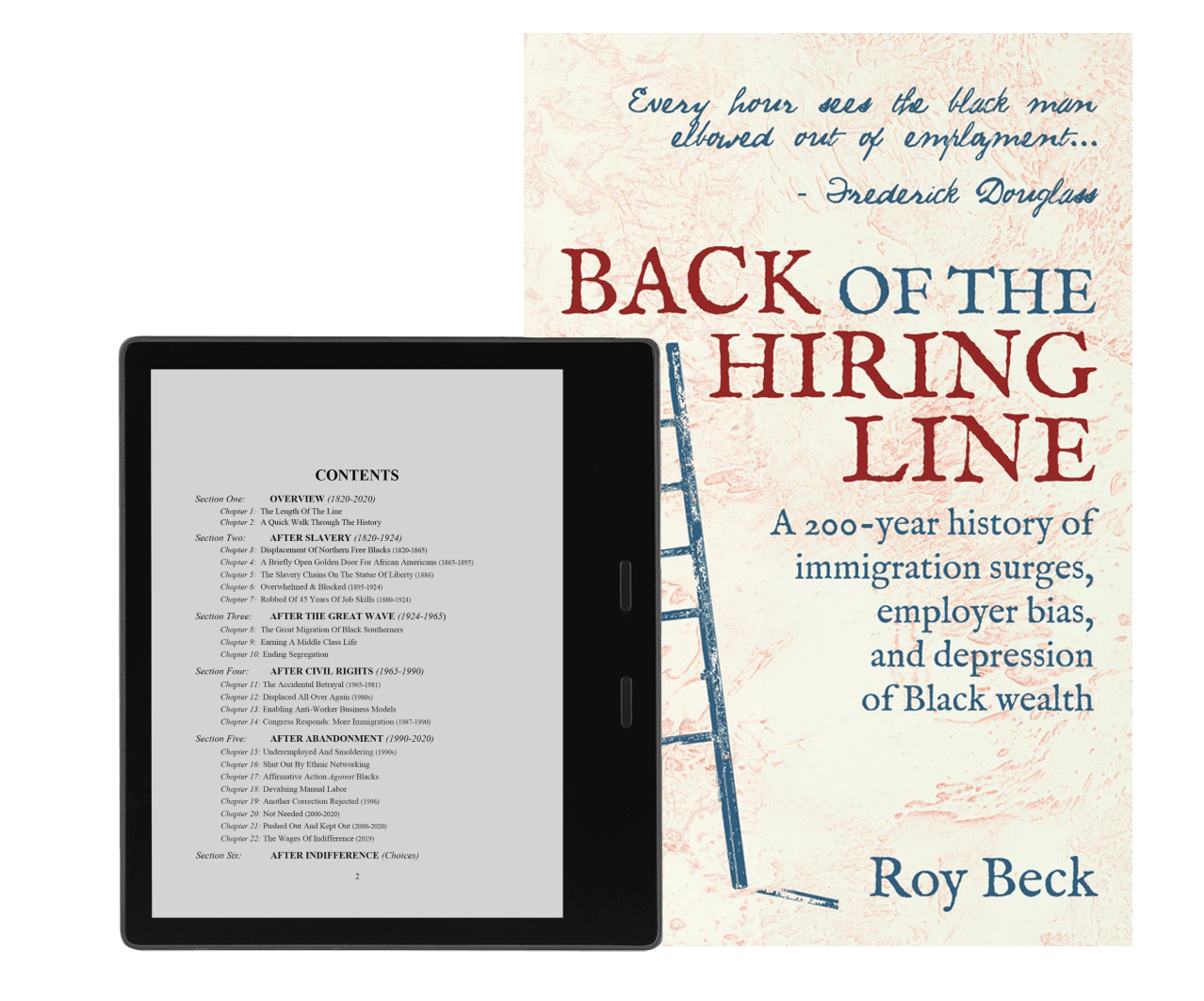

About one-third of this greatly-expanded Second Edition is composed of new research and details that enrich the immigration/labor market backstory of the deep racial divide and economic inequality of America in the 2020s. Also added are photographs of historic Black publishers and other leaders, a full index, nearly double the footnote sourcing, a new Introduction, and fresh philosophical insights that have emerged from new voices since the 2021 original edition.
8 pages · Updated September 2026
INTERVIEWS and REVIEW COPIES
Roy Beck and NumbersUSA staff are available for broadcast, podcast, and print interviews. Review copies and high-resolution cover art are available on request.
Contact: Katelyn Moon, Keybridge Communications — katelyn@keybridge.biz


NOT with the PRESS?
For questions about the book, email ER@numbersusa.org or submit a request through the NumbersUSA help desk.
BOOK at a GLANCE
- Author: Roy Howard Beck
- Publisher: NumbersUSA Education & Research Foundation, Arlington, Virginia
- Edition: Second Edition (First Edition 2021; portions originally published by W. W. Norton)
- Publication date: July 27, 2026
- Extent: 414 pages, including notes, index, and photographs
- ISBNs: Hardcover 978-1-7379547-6-7 · Paperback 978-1-7379547-7-4 · Ebook 978-1-7379547-1-2
- Audiobook: First Edition only — 978-1-7379547-2-9
The BOOK in BRIEF
For most decades since 1820, American employers have used surpluses of foreign labor to avoid recruiting and advancing former slaves, and then their descendants, on the nation’s job ladders. The effect, Roy Beck argues, has been to steal Black wealth before it could be earned.
Across nearly a century and a half, Frederick Douglass, Booker T. Washington, W.E.B. Du Bois, A. Philip Randolph, and Barbara Jordan all delivered the same warning: an oversupplied labor market hits hardest the workers with the least leverage.
The history carries a lesson well beyond Black America. In the four decades after Congress cut immigration in 1924, tight labor markets helped make the United States a middle-class country, with the fastest income growth in the nation’s history and shrinking inequality among classes as well as races.
The GAP TODAY
- The median Black household in the 2020s holds net assets of roughly one-tenth those of the median White household. (p. 1)
- In 1960, all but 12% of U.S.-born Black men without college were in the labor force. By 2024, 35% of those aged 18–64 were outside the labor force altogether. (p. 13)
- 25% of Black children under 18 lived in poverty in 2024, three times the rate for White children. (p. 13)
WHAT it MEANT for ALL AMERICAN WORKERS
- In the four decades after the 1924 Act, the United States became a middle-class country, sustained tight labor markets drove the fastest income growth for workers in U.S. history, and inequality among classes and races shrank. (p. 132)
- Between 1940 and 1980, real incomes of White men rose two-and-a-half-fold; those of Black men rose four-fold. (p. 133)
- By the 1960s, sweatshops had virtually disappeared and Americans of all backgrounds had reached middle-class status. (p. 137)
- Meatpacking paid an average $37 an hour in 2026 dollars in 1977. After the industry replaced American workers with foreign labor, the wage fell below $24 by 1987 and below $20 by 1992. (p. 186)
The BARBARA JORDAN BLUEPRINT
The bipartisan U.S. Commission on Immigration Reform, chaired by civil rights icon Barbara Jordan and appointed by President Clinton, recommended an eventual ceiling of 550,000 green cards a year, 40% below the 912,000 issued in 1996. It also called for cutting employment-based green cards from 140,000 to 100,000, setting permanent refugee resettlement at 50,000, and creating the verification system that became E-Verify. Congress rejected the package. It authorized E-Verify but declined to require employers to use it. (pp. 242–250)
ABOUT the AUTHOR
Roy Howard Beck has researched and written about the effects of immigration policy on Black Americans since the 1992 riots in South Central Los Angeles. A 1970 graduate of the University of Missouri School of Journalism, he was a daily newspaper chain’s Chief Washington Correspondent during the consideration and passage of the 1990 Immigration Act. Encyclopaedia Britannica selected his Atlantic Monthly article on immigration for its Annals of America series. His “gumballs” video presentation has been viewed more than 200 million times. Beck founded the bipartisan NumbersUSA Education & Research Foundation after Barbara Jordan’s death in 1996. Back of the Hiring Line is his fifth book.
Suggested on-air identification: Roy Beck, author of Back of the Hiring Line and former Washington correspondent.
PRAISE
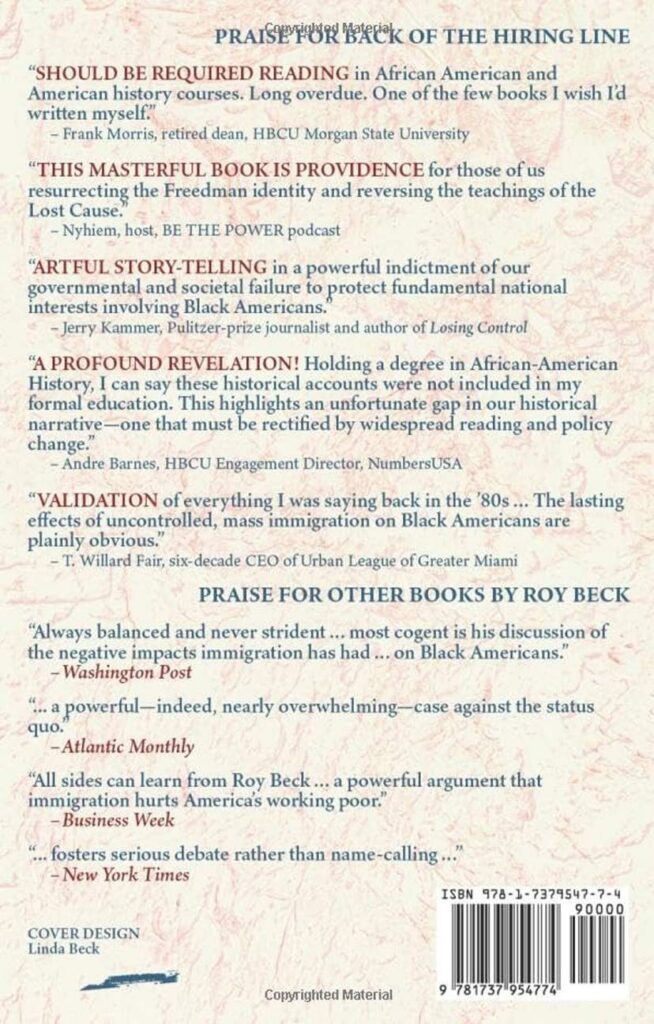
“Artful story-telling in an extensive, well-documented, and powerful indictment of our governmental and societal failure to protect fundamental national interests involving Black Americans.”
— Jerry Kammer, Pulitzer Prize–winning investigative journalist“A robust and startling two-hundred-year account.”
— American Affairs